Philosophy / Freedom / Knowledge
Giordano Bruno.
The Courage to Doubt.
Not only what appears absurd. Even what everyone considers obvious.
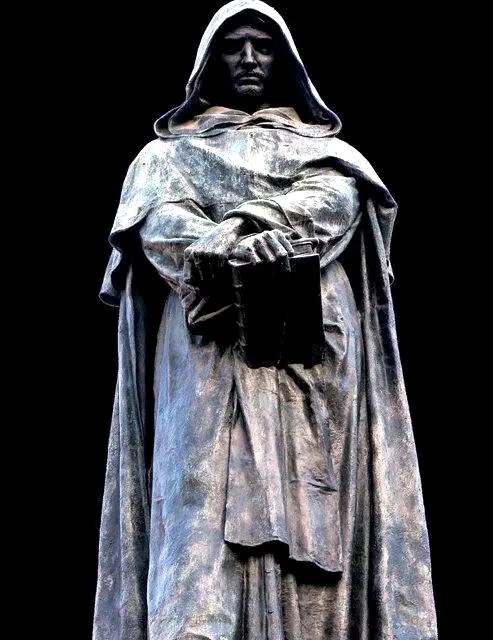
On February 17, 1600, Giordano Bruno was burned at the stake in Campo de' Fiori, Rome, after condemnation by the Roman Inquisition.
More than four centuries later, his ideas still invite us to question what we think we know.
There is a popular quotation attributed to him about humanity awakening from oblivion and realizing that it has surrendered control of its existence to a deceptive mind.
Beautiful. Dramatic. Almost irresistible.
Unfortunately, there is no reliable evidence that Bruno ever said it.
But he did write something far more interesting.
In his dedication to Emperor Rudolf II, in 1588, Bruno argued that intellectual inquiry should be free from inherited beliefs, established authorities and even the apparent certainty of common sense.
He wrote:
"E siano per me ugualmente dubbie tutte le cose..."
Let all things be equally open to doubt.
Not only what appears absurd.
Even what everyone considers obvious.
Now, that is a dangerous idea.
Not because questioning everything automatically makes us right. Quite the opposite.
It forces us to acknowledge that our convictions, however comfortable, may be wrong.
And there is a significant difference between someone who questions authority because they wish to replace it with their own, and someone who questions authority because they genuinely want to understand.
The first seeks power.
The second seeks knowledge.
Bruno was not infallible. Neither were the philosophers before him, nor those who came after him.
And neither are we.
I have always found it rather curious that people can admire great thinkers while being so reluctant to question their own thoughts.
Freedom of thought does not mean being free from doubt. It means having the courage to live with it.
Four hundred years later, that remains a demanding proposition.
Sources and attribution
The quoted Italian sentence is from a passage attributed to Bruno’s dedication to Rudolf II in Articuli centum et sexaginta (1588). See the published passage. For the historical account of his execution, see Treccani. The popular “awakening from oblivion” quotation is not reliably sourced.