Truth / Thinking / Judgment
Once Upon a Time,
Hannah Arendt.
What happens when lies multiply until nobody believes anything?
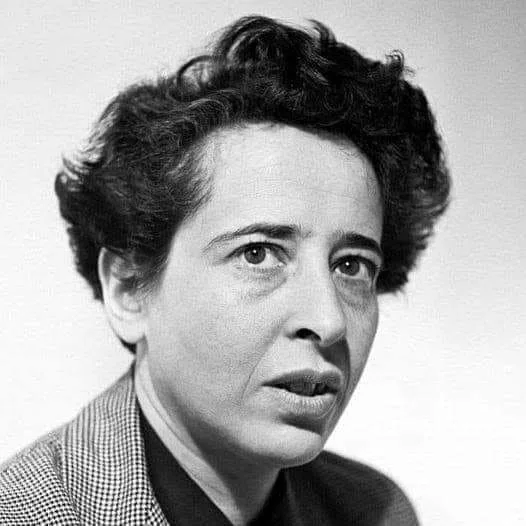
There was once a woman named Hannah Arendt.
She spent much of her intellectual life examining the relationships between truth, power, responsibility and the human capacity to think.
One day, I came across a quotation attributed to her about systematic lying and the destruction of people's ability to distinguish truth from falsehood.
Powerful words.
There was just one problem.
She never actually said them in that form.
Which is rather amusing, considering that the quotation itself warned about the manipulation of truth.
What Arendt did say, in an interview with Roger Errera, was:
"If everybody always lies to you, the consequence is not that you believe the lies, but rather that nobody believes anything any longer."
And that, I think, is far more disturbing than simply being deceived.
Because when people stop believing that truth can be established, they don't necessarily become more skeptical or more intelligent.
They may simply stop caring.
Every statement becomes an opinion. Every fact becomes negotiable. Every contradiction becomes another excuse to shrug.
And when the ability to judge disappears, freedom becomes an increasingly decorative concept.
We live in a world overflowing with information, yet information and understanding are two entirely different things.
Perhaps the real challenge isn't learning what to believe.
Perhaps it's learning how to think without having someone else do the thinking for us.
And, naturally, being prepared to discover that we were wrong.
Including about Hannah Arendt.
A note on attribution
The longer, popular quotation about systematic lying is an inaccurate attribution. The passage cited above comes from Arendt’s interview with Roger Errera, published in 1978. Sources: original interview and Hannah Arendt Center’s attribution note.