Consciousness / Metaphysics / Reflection
The Kingdom We Never Left.
A Personal Reflection on Consciousness, Time, and God's Presence
Florijan Veneruzzo
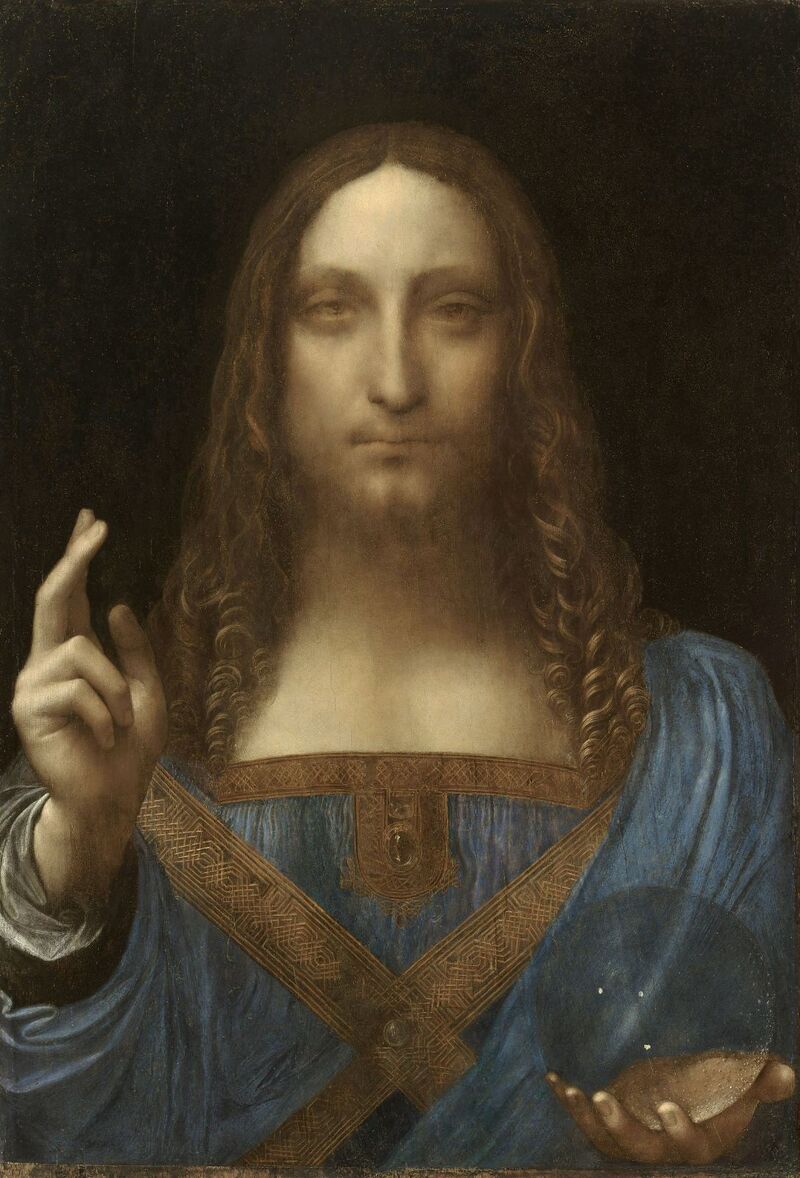
While contemplating Leonardo da Vinci's Salvator Mundi, my attention was drawn to three white dots inside the transparent orb held in Christ's hand. Three seemingly insignificant dots led me to a question that gradually evolved into an entirely different understanding of the Kingdom of Heaven.
What if we imagined these three dots, regardless of Leonardo's actual intentions, as representing three states of consciousness? Primordial potential, individual consciousness, and higher consciousness. Three different ways of experiencing the same reality. A human being develops an identity and gradually becomes aware of themselves as a separate being. We come to know the world through the limitations of our senses. In doing so, we perceive ourselves as separate from other people and from everything around us.
But what if that separation is merely a limitation of our perception? What if individual consciousness is actually an expression of a broader, universal consciousness to which we have always belonged?
In that case, God would not necessarily be a being separate from the world, but rather the source and totality of existence. Something we cannot fully comprehend through the limitations of our own experience. The Kingdom of Heaven would then take on an entirely different meaning. Perhaps it is a state of awareness in which we finally understand that we were never separate from the whole to which we belong.
And then the Day of Judgment would not be a moment when some are rewarded and others punished. Perhaps it is an individual moment of awakening, a transition from a limited perception of reality to a more complete understanding of it. In such an interpretation, no one needs to suffer, be rejected, or end up in hell. Those who have not reached this realization simply continue to experience the world as they did before. The Kingdom is not denied to them. But there is another possibility.
What if time belongs only to our individual experience, while universal consciousness exists beyond it? Then returning to the source would not be an event in time. We would not become part of the whole; we would simply realize that we had always been part of it.
If consciousness truly exists independently of the body and time, then death would not mean its ultimate disappearance.
This is, of course, a metaphysical assumption. Nevertheless, it raises an intriguing question: could what we call eternity actually be existence beyond the very concept of time? In the Gospel of Matthew, we read: "For where two or three are gathered together in my name, there am I in the midst of them." I do not know whether that is love. Perhaps love is simply our way of experiencing that connection. If we are all part of the same whole, no one is forgotten and no one is ultimately lost.
Perhaps we do not need to return to the Kingdom of Heaven. Perhaps we simply need to realize that we never left it.
Keep the conversation going