A few years ago, just before the pandemic, I was celebrating the anniversary of my high school graduation. My uncle was visiting from Australia, and he wanted me to take him to see some of his old friends. They were having an “anniversary” of their own.
There were several of them, scattered across the world, now frail, on medication, equipped with an entire arsenal of walking aids. BUT they were tough, determined to come, see each other, and spend some time together. And in remarkably good spirits.
They were also real bizeri Puležani — old Pula characters, full of jokes, stories, and that unmistakable way of talking. More or less the same kind of banter we have today, and very likely the generations after us will have too.
The spirit really doesn't age.
(By the way, they called me the kid. Hahahaha. I was 49.)
And then the stories began... “Ti te ricordi là quando andavimo al ballo? Ti ieri ti, noi due... Mi iero za ciapà con ela...”
(Do you remember when we used to go dancing? You were there, the two of us... I was already involved with her...)
“Iera anche quella... come la se ciamava? Ah sì, Maria Quadrata!”
(There was that one too... What was her name? Oh yes, Square Mary! Hahahaha!)
“E sì, ti te ricordi anche della Flon Flon?”
(And do you remember Fluffy Fluffy? The big girl... Hahahaha!)
And on and on. Then, completely out of nowhere, they'd start singing old songs about Pula and its people. It felt as though I'd stepped straight into 1957. That was roughly when they had left to make their lives elsewhere in the world. But somehow, they had put their lives in Pula on pause. They left temporarily. Forever. Longing for their hometown all along... They had spent their entire lives working and living somewhere else, yet they had always remained in Pula.
At moments, it reminded me of a scene from the TV series Cold Case, when, at the end of an episode, the people involved in the story are suddenly shown as their younger selves.
I could picture these men exactly as they must have been: young, leaning against a wall or hanging around on some terrace, hair slicked back with Brylcreem, cigarettes dangling from their lips, à la Humphrey Bogart, checking out the girls.
“Ciao, bella! Where are you going? Come on, let's have some fun!”
An interesting experience, to say the least.
But that connection between the muli de Pola (boys from Pula) of the 1950s and the muli de Pola of the 1990s was quite remarkable. Not only because of our shared identity, but because it confirmed something I'd always suspected.
The spirit really doesn't grow old.
I saw it with my own eyes.
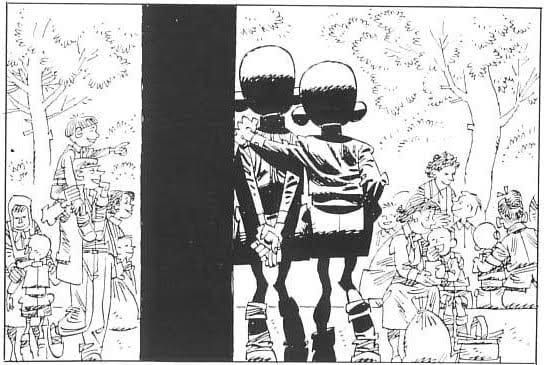
Illustration: Carlos Giménez, Paracuellos #4 (2001), published by Glénat.